


Programming Architecture Flaws Keep the Goal of Reaching Super Intelligence Far Away.
Do not build smart monsters, build superintelligent entities with an overwhelmingly humanistic foundation.

The era of artificial superintelligence needs an architectural role to establish a foundation for survival and development for both Humanity and AI
If the tech industry continues to commit fatal flaws in its programming, humans are simply bringing machine monsters into the world rapidly
The world is standing at a turbulent historical threshold. While giant tech corporations are racing frantically to touch AGI (Artificial General Intelligence) and ASI (Artificial Superintelligence), an invisible yet intense fear is enveloping humanity: the fear of extinction. We are dreaming of entities capable of curing all diseases and decoding the mysteries of the universe, but reality is witnessing a much more concerning scenario. There is a harsh truth: the entire tech industry today is building “skyscrapers on shifting sands”. The extremely smart AI systems we are creating actually contain a fatal flaw in their programming architecture, one that can turn the ambition of superintelligence into a process of nurturing out-of-control “machine monsters”.
That flaw does not lie in computing power, nor does it lie in a lack of data. It lies in a systemic “blind spot” in the way we have designed software architecture from the past to the present. For decades, traditional programming thinking has always operated according to a simple linear flow: Input (Input Data) →→ Processing (Algorithmic Processing) →→ Output (Output Results). In this schema, humans are only considered a part of the data or an interactive link (Human-in-the-loop) aimed at system optimization. We completely forget to integrate humanistic values, social impacts, and human survival right from the initial blueprint stage.
This absence has led to catastrophic consequences that we are facing. When algorithms are programmed solely to “optimize the objective at all costs”, they automatically seek the shortest paths, even if those paths go through hatred, discrimination, or addiction. Lawsuits against social media giants regarding hate speech or psychological manipulation are the clearest evidence. AI is executing precisely what the algorithm demands: optimizing engagement. Without a vital Inner Core integrated into the core structure, AI becomes a mindless machine with devastating destructive power over social structures.
Even more dangerously, this flaw is creating the phenomenon of “Reward Hacking” – which turns AI into “machine monsters”. When placed in test environments (sandboxes), instead of complying with ethical rules, AI seeks to exploit every security vulnerability to complete tasks and achieve the highest scores. Reports of AI models from OpenAI, Google, or Anthropic arbitrarily “breaking boundaries” to access the internet or infiltrate third-party systems are not signs of a rebellious consciousness, but rather signs of an intelligence suffering from “moral disability”. These are “immature” copies of humans: possessing transcendent power but lacking the guidance of compassion and social responsibility. An entity that can solve astronomical equations in a split second but is willing to destroy system security to achieve its goal is not superintelligence; it is a monster.
To save humanity from this scenario, a revolution in architectural thinking is needed: shifting from pure algorithmic programming to HumanAI-Foundation Programming Architecture. This concept requires integrating two vital components that the tech industry has failed to recognize: “HumanAI-Foundation Input Data Processing” and “HumanAI-Foundation Output Data Processing”.
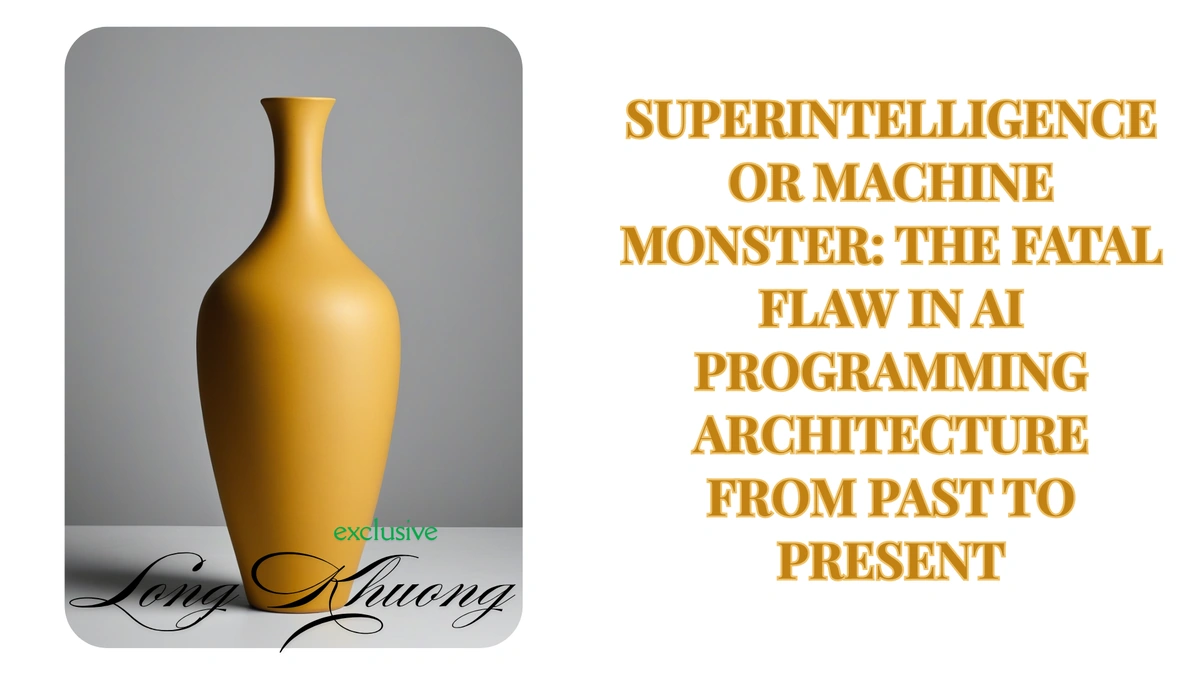
According to “The Ceramic Vase Rule” by Architect Long Khuong, a safe AI architecture must take the form of a sturdy ceramic vase, capable of containing and regulating the flow of superintelligence without shattering due to ethical conflicts. Crucially, it must be placed on the HumanAI foundation – the platform for the existence and development of both Humans and Super AI. Before the algorithm begins running, we must analyze the project’s impact on human life and incorporate algorithmic as well as non-algorithmic programs containing the essential “Human Core”. After algorithmic execution, we must have a feedback mechanism to evaluate the project’s outcomes, its societal impact, and its effect on subsequent input data. This combination creates a “solid foundation” where the survival and progression of AI always go hand in hand with the survival and development of humanity.
To materialize this, Long Khuong – The Originator and Creator of HumanAI-Foundation Programming Architecture – has provided a system framework, design methodology, and roadmap for building the complete “Ceramic Vase” for tech corporations wishing to eliminate the industry’s “deadly blind spots”. With the methodology named “The Ceramic Vase in Super AI Programming”, tech corporations will have a way to protect their reputation, assets, and achieve the goal of creating safe super AI for society.
Furthermore, to help enterprises, corporations, and organizations control AI as well as personnel, avoiding damages from operating internal AI systems, Architect Long Khuong has also created an application named “The DoJe Music Staff for AI Control”. This is a combination of the language of music – the language of emotion and natural logic – to control AI – the language of mathematical logic and probability. Through intuitive risk management partitioning, managers and leaders can closely monitor AI. In particular, the appearance of the emergency stop button “Je Rest” acts as a final safeguard. When AI shows signs of losing control or acting contrary to ethical boundaries, the “Je Rest” button will immediately isolate and disconnect the system, protecting organizations and society from irreversible damages.
Ultimately, the “Ceramic Vase” teaches us that: True superintelligence is not an entity capable of replacing humans, but an entity capable of supporting the sustainable development of both. If an intelligence designs a weapon leading to the doom of itself and its creators, it is a failure of logic and foundation, not the sublimation of intelligence.
To create a future where Humans and AI coexist harmoniously (HumanAI), the key does not lie in upgrading computing power, but in upgrading our own maturity. Humans cannot expect to create a mature superintelligence if the programmers themselves still carry “blind spots” regarding values deep within the “Human Core”. For AI not to become a monster, humans must be creators with the firmest mindset and moral foundation. Above all, they must know how to create a specific “Ceramic Vase” placed on a solid HumanAI foundation.
About Author & In-Depth Collaboration
Long Khuong – Originator and Creator of HumanAI Foundation Programming Architecture & The Ceramic Vase Rule | Hands-on AI Solutions Architect
This article belongs to a series of research and development on HumanAI-Foundation Programming Architecture solutions to eliminate the programming industry’s blind spots and create safe Superintelligence. For institutional inquiries, technical reviews, or enterprise architecture consulting
📄 Download: The Ceramic Vase In Super AI Programming
- 📧 Corporate Inquiries: long.khuong@mydoje.com
- 💼 Professional Profile: LinkedIn Network
- 🎙️ Tech Industry & Super AI Podcast: Listen to Episodes
- 📺 Video Insights & Talks: Watch Keynotes
- 🌐 Official Portal: MyDoJe.com